Home
How YOU can help
About Breast Cancer
About MBCC
Legislative Advocacy
MBCC Projects & Campaign
Media
Education and Outreach
Newsletters
Calendar
Against The Tide
FAQs
LINKS
Combining all age groups, white (non-Hispanic) women are more likely to develop breast cancer than black women. However, black women are more likely to die of breast cancer than white women.
|
PREVENTION IS THE CURE
The Massachusetts Breast Cancer Coalition, dedicated to challenging all obstacles to the eradication of breast cancer, believes that compelling research exists linking environmental toxins to the dramatic rise in breast cancer incidence over the past several decades.
We hope that visitors to the site will dare to ask the questions, “What is causing high rates of breast cancer?” and “What is the breast cancer movement doing to stop 1 in 7 women from developing the disease in the first place?”
To Learn More About Current Efforts to Address Concerns About Environmental Links to Breast Cancer, Click Here.
MBCC has an opening for a Program/Outreach Director (Part-time to full-time, long term temporary) as well as for a Part-time bookeeper. CLICK HERE for more information.
|
MBCC discusses Safe Cosmetics with WBZ Channel 4 news. CLICK HERE to check it out!
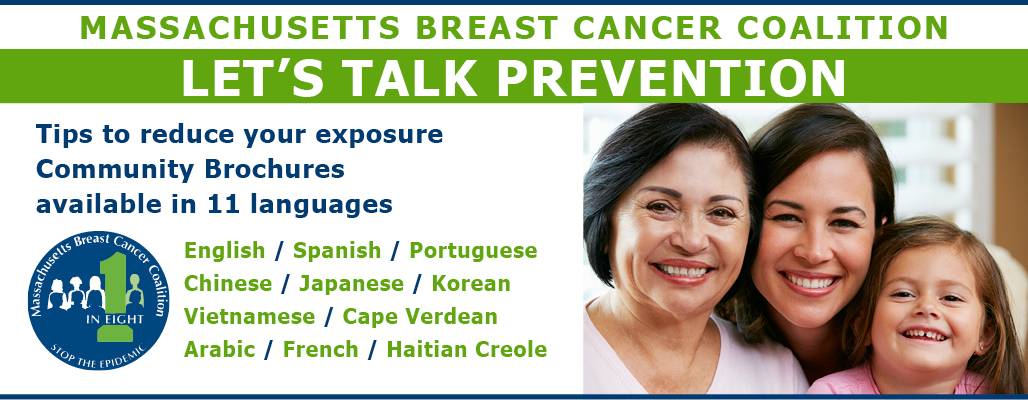
What Can I Do to Reduce My Exposure to Environmental Toxins?
1. Change your cleaning and personal care products over to natural ones or learn how to make your own.
2. Start buying food that is grown without synthetic pesticides, better if they were grown locally.
3. Avoid using pesticides in your home, on your lawn/garden, or on your pet – there are alternatives to choose from.
4. Avoid charring food when grilling, use marinades and reduce heat.
Find Additional Suggestions to Create a Healthier Environment in Your Home, Click Here. |
| Environmental Justice |
Advocacy |
Increasing evidence demonstrates that women of color, particularly African-American women, have a higher mortality rate from breast cancer than white women; despite lower incidence rates. Beyond typical explanations, such as inadequate access to early screening, detection and treatment along with the rolse of genetic factors; new research questions the additional risks of increased exposure to environmental toxins.
To learn more about environmental racism and its impact on health, read this report authored by Associate Professor of Sociology at Northeastern University Daniel Faber and Associate Professor of Sociology Eric J. Krieg at Johnson State College. |
BREAST CANCER PREVENTION RESEARCH
*********
HELP US SEEK FUNDING $1M FOR THIS FUNDING THIS YEAR:
BECOME AN ADVOCACY ALLY
WITH AS LITTLE AS A FEW MINUTES A YEAR!
|
| Current Campaign |
rBGH, Milk & Breast Cancer
Bovine Growth Hormone, called rBGH, is a genetically modified hormone injected into 35% of dairy cows in the US in order to increase milk production.
rBGH is banned in all 25 countries of the European Union, Canada, Australia, New Zealand and Japan because the hormone is implicated in serious health conditions such breast, colon, prostate, lung and other cancers and can lead to antibiotic-resistant bacteria in our bodies making it more difficult to fight infection.
It's time to make sure that rBGH-free dairy products are the only dairy products available in our schools, supermarkets, hospitals, coffee-shops, restaurants, etc.
LEARN MORE HERE! |
| Subscribe Now |
Frequently Asked Question |
Looking for a way to stay current with what's happening? Subscribe to our E-NEWSLETTER
|
Visit our Frequently Asked Questions to learn the answers to questions like, "How is MBCC different from other breast cancer organizations?" and "What do we know about environmental links to breast cancer?" |
| |
|
|
 |
 |